
Consider an AI agent tasked with monitoring market trends for a financial firm over several weeks. The agent must track dozens of data sources, remember previous analysis patterns, and maintain context about ongoing investigations. When the agent restarts after a system update or needs to pause for human approval, it cannot simply forget everything and start fresh. The agent must retain its accumulated knowledge, remember which sources it already checked, and continue exactly where it left off.
Managing long-running agent state is critical for enterprise AI workflows. SmythOS addresses this challenge through its dedicated runtime environment that ensures agents maintain context, memory, and execution continuity across sessions. Unlike frameworks that require manual state management, SmythOS provides built-in mechanisms for state persistence, recovery, and coordination. This enables agents to run reliably over extended periods without losing progress or context.
The SmythOS Runtime Environment treats agents like managed processes rather than temporary scripts. When an agent pauses, crashes, or needs to coordinate with other agents, the platform automatically handles state preservation and recovery. This runtime-first approach eliminates the complexity of manually coding state management logic, allowing agents to focus on their core tasks while the platform ensures they maintain continuity across sessions and system changes.
What Is the SmythOS Runtime Environment (SRE) and How Does It Manage State?
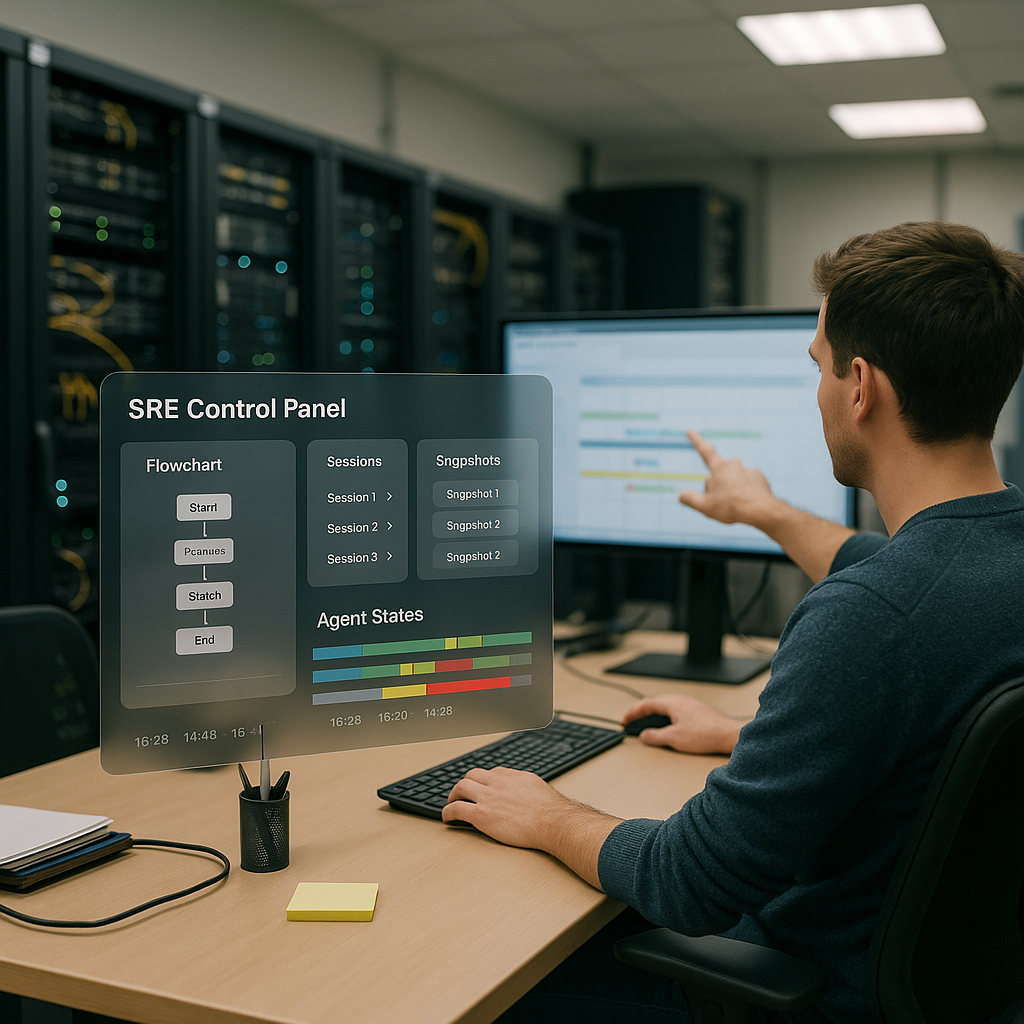
The SmythOS Runtime Environment serves as the foundational kernel for AI agent operations. This agent-first execution platform manages computational resources and state persistence at the system level. Unlike traditional frameworks that require developers to build state management from scratch, SRE handles these complexities automatically through its kernel-level infrastructure.
SRE operates as a comprehensive operating system specifically designed for agentic AI workloads. The platform abstracts away the technical complexity of managing agent state, memory persistence, and resource coordination. This approach mirrors how traditional operating systems manage hardware resources for applications, but focuses entirely on the unique requirements of AI agents.
Core Architecture and Subsystems
The runtime environment divides functionality across specialized subsystems that work together seamlessly. Each subsystem handles specific aspects of agent execution and state management. This modular design ensures efficient resource utilization and reliable performance across different deployment scenarios.
The Memory Manager stands as the primary component for state persistence and context management. This subsystem maintains agent state during execution, manages conversation history for language models, and implements multi-tiered caching systems. The caching infrastructure spans both RAM and Redis implementations, enabling fast data retrieval and optimal performance.
Agent Manager orchestrates the complete agent lifecycle from initialization to termination. This subsystem monitors agent performance, coordinates complex workflows, and ensures consistent execution across sessions. The Agent Manager works closely with the Memory Manager to maintain continuity between agent interactions.
| Subsystem | State Management Function | Key Benefits |
| Memory Manager | Agent context, conversation history, caching layers | Fast retrieval, session continuity, context preservation |
| Agent Manager | Execution state, lifecycle management, workflow coordination | Reliable orchestration, performance monitoring, task persistence |
| IO Subsystem | Data persistence, storage abstraction, logging | Unified interface, scalable storage, audit trails |
| Security Manager | Identity management, access control, credential storage | Multi-tenant isolation, secure state boundaries, policy enforcement |
Database Persistence and Long-Term Memory
SRE implements sophisticated database persistence mechanisms that store agent memory for extended periods. This long-term storage system enables agents to recall information from previous sessions, whether those interactions occurred hours or days earlier. The persistence layer operates transparently, requiring no additional configuration or custom code from developers.
The platform maintains frequently accessed integrations in a warm state, reducing latency for common operations. This optimization ensures that agents can quickly access external services and data sources without experiencing connection delays. The warm integration strategy significantly improves response times during agent interactions.
Session continuity represents a crucial advantage of SRE’s state management approach. Agents maintain complete awareness of their previous activities, learned patterns, and accumulated knowledge. This continuity allows for more sophisticated agent behaviors and improved user experiences across multiple interaction sessions.
Comparison with Traditional Frameworks
Traditional AI frameworks typically require developers to implement state management manually through custom code and external databases. This approach creates significant development overhead and increases the potential for bugs or data loss. Developers must handle session storage, context management, and state synchronization independently.
SRE eliminates these complexities by providing built-in state management at the kernel level. The platform automatically handles memory persistence, context preservation, and session continuity without requiring custom implementation. This fundamental difference allows developers to focus on business logic rather than infrastructure concerns.
The kernel-level approach also ensures consistent state management across different deployment environments. Whether running locally, in cloud infrastructure, or hybrid configurations, agents maintain identical state management behavior. This consistency simplifies development, testing, and production deployment processes significantly.
How Does SmythOS Ensure Reliability and State Recovery for Long-Running Agents?
SmythOS transforms agent reliability through its built-in SmythOS Runtime Environment (SRE). This sophisticated system automatically handles failure recovery without requiring manual intervention. When issues strike, agents continue running seamlessly.
The platform’s failure recovery mechanisms operate at multiple levels. If an agent instance crashes during execution, SRE immediately detects the failure. The system can retry the failed operation or spin up a new instance within seconds. This automatic response ensures continuous operation.
State preservation forms the backbone of SmythOS reliability. Every agent action gets captured through immutable audit trails. These comprehensive logs record each decision, data transformation, and external interaction. When failures occur, the system reconstructs the exact state from these detailed records.
Consider a financial trading agent processing market data and executing trades. Mid-workflow, a network timeout causes the agent to crash while analyzing a complex portfolio. SmythOS automatically detects the failure, preserves all processed data, and launches a replacement agent. The new instance resumes analysis from the exact interruption point, completing the trade sequence without missing critical market opportunities.
Error isolation prevents small failures from cascading into system-wide issues. When one component fails, SmythOS contains the problem within that specific area. Other agents continue operating normally. This architecture maintains overall system throughput even during localized failures.
Automatic retry mechanisms handle transient issues intelligently. The system distinguishes between temporary network glitches and persistent problems. For temporary issues, SRE retries operations with exponential backoff. For persistent failures, it triggers failover procedures to alternative resources or instances.
The business impact is substantial. Organizations eliminate the costly downtime associated with manual failure recovery. Agents maintain productivity during peak load scenarios. Teams focus on strategic work rather than monitoring system health. SmythOS delivers enterprise-grade reliability that scales with business demands.
What Are the Key Advantages of SmythOS State Management Over Code-Based Frameworks?
Built-in State Handling Eliminates Development Overhead
SmythOS treats state management as a fundamental platform capability rather than an optional feature. The Smyth Runtime Environment (SRE) includes optimized routines specifically designed for maintaining agent state across interactions. Code-based frameworks require developers to build these systems from scratch, often leading to inconsistent implementations and performance bottlenecks.
This architectural difference means developers can focus on solving business problems instead of wrestling with infrastructure challenges. Traditional frameworks force teams to spend significant time designing state persistence, memory coordination, and data flow mechanisms. SmythOS removes this burden entirely by providing these capabilities as core platform services.
Performance Optimization Through Dedicated Architecture
The SRE avoids the computational overhead associated with dynamic code generation at runtime. While code-based frameworks often create and execute new code for each state operation, SmythOS uses pre-optimized routines that deliver consistent performance. This approach eliminates the unpredictability that comes with runtime code compilation and execution.
Performance remains stable regardless of workload complexity or agent interaction patterns. Code-based solutions frequently experience performance degradation as state management requirements grow more complex. SmythOS maintains consistent response times through its purpose-built state handling architecture.
Unified Context Through Integrated Memory Systems
SmythOS agents access shared context through integrated memory systems and vector databases without requiring manual configuration. Information flows seamlessly between agent steps through the platform’s unified memory architecture. Developers don’t need to design custom data structures or implement complex state sharing mechanisms.
The integrated vector database enables sophisticated context retrieval and knowledge sharing between agents. Code-based frameworks require developers to manually integrate and configure vector databases, manage data synchronization, and handle potential conflicts. SmythOS handles these operations automatically through its orchestration layer.
| Aspect | Code-Based Frameworks | SmythOS |
|---|---|---|
| State Implementation | Manual coding and architecture design | Built-in platform feature |
| Memory Coordination | Custom development required | Automatic shared memory systems |
| Performance Optimization | Developer responsibility | Pre-optimized runtime routines |
| Vector Database Integration | Manual setup and maintenance | Integrated and automatically managed |
| Concurrency Handling | Custom threading and synchronization | Platform-managed concurrency |
| State Persistence | Database design and management | Automatic state coordination |
Automated Multi-Agent Coordination
The platform orchestrates multi-agent workflows where agents pass information through shared memory without manual coordination logic. SmythOS manages the complex task of ensuring agents can collaborate effectively while maintaining data consistency. Traditional frameworks require developers to implement inter-agent communication protocols and resolve potential conflicts manually.
Agent collaboration happens transparently through the platform’s orchestration layer. Developers define agent roles and objectives while SmythOS handles the underlying coordination mechanisms. This automation prevents common issues like deadlocks, race conditions, and data corruption that frequently occur in manually coded multi-agent systems.
Infrastructure Abstraction Enables Business Logic Focus
SmythOS abstracts away the technical complexities of state management, allowing development teams to concentrate on business logic implementation. The platform automatically handles concurrency control, scheduling coordination, and state synchronization. Code-based frameworks force developers to become infrastructure specialists before they can build effective agent solutions.
This abstraction significantly reduces the technical expertise required for agent development. Teams can deploy sophisticated multi-agent workflows without deep knowledge of distributed systems, database management, or concurrent programming. SmythOS transforms complex infrastructure challenges into simple configuration decisions, accelerating development cycles and reducing maintenance overhead.
How Does SmythOS Handle State Across Different Deployment Environments?
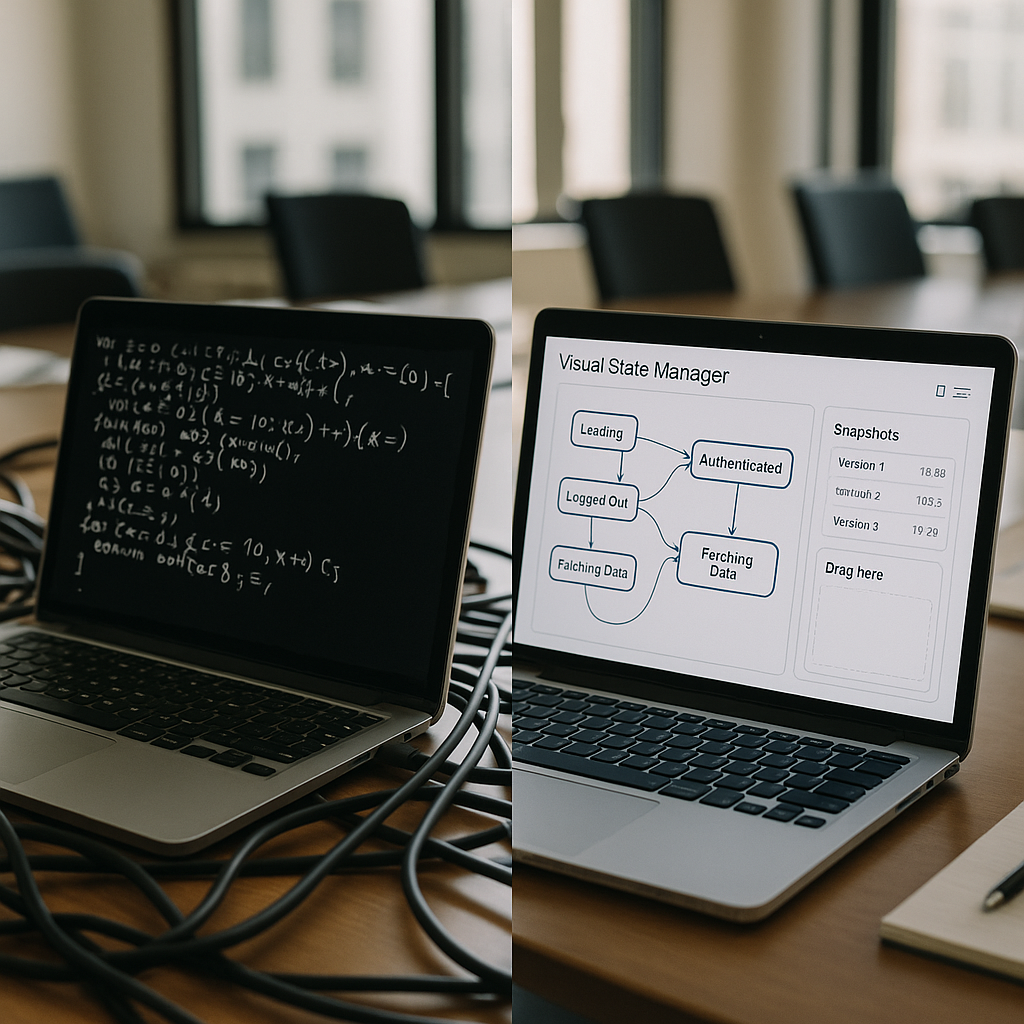
SmythOS delivers consistent state management through our portable runtime architecture built into the Smyth Runtime Environment (SRE). This lightweight 50MB runtime maintains identical state handling capabilities whether deployed on Linux servers, Mac workstations, Windows systems, or ARM-based edge devices. Our unified approach eliminates the complexity of managing different state systems across diverse infrastructure.
The SRE provides environment portability without sacrificing functionality. Agents maintain their context, memory, and learned behaviors seamlessly as they move between cloud instances, on-premises servers, and edge locations. This consistency stems from our standardized state persistence mechanisms that abstract away underlying platform differences while preserving full operational capability.
Our deployment flexibility addresses critical enterprise concerns about data locality and control. Organizations can deploy agents in their preferred environment while benefiting from SmythOS’s managed state handling. Whether running in our managed Agent Cloud for instant scalability, private Enterprise Cloud for enhanced security, or local environments for complete data sovereignty, state management remains consistent and reliable.
Cross-platform state management extends beyond basic compatibility. Our architecture ensures that agent memory, conversation history, and learned patterns persist identically across all supported platforms. An agent trained on a Windows development machine maintains the same state when deployed to a Linux production server or an ARM-based edge device. This eliminates environment-specific state corruption or data loss during deployment transitions.
We support proper state isolation between staging and production environments to enable safe testing workflows. Development teams can experiment with agent modifications in staging environments without affecting live production states. Our isolation mechanisms prevent staging data from contaminating production systems while allowing realistic testing scenarios that mirror live agent behavior.
The platform’s unified state persistence works regardless of deployment location. Agents running in cloud environments benefit from managed backup and recovery services, while on-premises deployments maintain complete control over state storage and access patterns. Edge deployments can operate with local state persistence and optional synchronization with central systems when connectivity permits.
Conclusion: Enterprise-Ready State Management for Production AI Agents

SmythOS solves the long-running agent state challenge through its purpose-built runtime environment that handles memory persistence, failure recovery, and state coordination automatically. By providing built-in state management at the platform level, SmythOS eliminates the engineering effort required to build and maintain custom state infrastructure. Organizations can deploy reliable, long-running agents that maintain context across sessions while focusing on business value rather than infrastructure concerns.
The SRE’s architecture ensures agents remain consistent, auditable, and scalable—making SmythOS ideal for enterprise production deployments where state management is critical. With enterprise-grade security, visual workflow development, and seamless deployment capabilities, SmythOS transforms complex state management challenges into manageable solutions that deliver immediate business value.