
Most people have experienced that moment when their favorite song comes on and they want to sing along confidently. Yet many hesitate, worried they lack natural talent or will sound terrible. The truth is that anyone can learn to sing well with the right foundational knowledge and consistent practice.
Learning how to sing starts with understanding the fundamentals that support vocal development. Proper posture is critical. Standing with feet hip-distance apart, shoulders relaxed, chest lifted, and head balanced creates the foundation for healthy singing. Vocal health is equally important: staying hydrated, avoiding smoke, getting adequate sleep, and practicing vocal warm-ups protect the voice from damage.
Beginners should also learn to match pitch by playing a note, starting with Middle C, and reproducing it with their voice. Using apps like SingTrue or a tuner provides valuable feedback for developing pitch accuracy. Finding a comfortable vocal range early helps singers select appropriate songs and avoid strain. These foundational elements set up sustainable progress and prevent common beginner mistakes that can discourage new vocalists.
How Do Breathing and Breath Support Transform Your Singing?

Breath control forms the foundation of every powerful vocal performance. Think of your breathing system as the engine of a car. Without proper fuel flow, the engine sputters and struggles. Similarly, without controlled airflow, your voice lacks the power and consistency needed for compelling singing.
The singer’s breath differs dramatically from everyday breathing patterns. Most people breathe shallowly into their chest, which creates unnecessary tension in the throat and shoulders. Singers must retrain their bodies to use diaphragmatic breathing instead. This technique involves allowing your belly, ribs, and back to expand naturally as air fills your lungs completely.
Proper breath support creates what vocal coaches call “appoggio” – an Italian term meaning “to lean on.” This involves using your low abdomen and pelvic floor muscles to create gentle intra-abdominal pressure. Picture holding a balloon steady while slowly releasing air through a small opening. Your core muscles work together to maintain consistent air pressure without forcing or pushing.
The hiss exercise demonstrates this principle perfectly. Start by taking a relaxed breath through your open mouth, feeling your ribs expand outward. Then exhale slowly while making a steady “ssss” sound, like air escaping from a tire. As you hiss, gently engage your lower abdominal muscles by pressing down and out slightly. This creates the controlled airflow essential for sustained vocal phrases.
Breathing patterns directly impact vocal stamina and power. When you breathe correctly, your voice gains the support needed for long phrases without strain. The Farinelli triangle exercise builds this endurance systematically. Inhale quietly for four counts, allowing your ribs to expand. Hold your breath for four counts while maintaining that expansion. Finally, exhale on an “s” sound for eight counts, resisting the collapse of your ribcage.
Over-breathing creates more problems than it solves. Taking in excessive air actually increases tension throughout your body and makes breath control more difficult. Your body naturally knows how much air it needs. After singing a phrase, simply pause and allow natural inhalation to occur without forcing the process.
Panting exercises develop the quick breath control needed for rapid musical passages. Stand with relaxed shoulders and take quick, shallow breaths through your mouth while keeping the movement in your diaphragm rather than your chest. Continue for thirty seconds, focusing on controlled, even breaths that mimic the breathing patterns required during energetic songs.
The transformation from chest breathing to diaphragmatic breathing often feels uncomfortable initially. Your body must relearn the breathing patterns you used naturally as an infant. Lying on your back can help you rediscover this natural breathing rhythm. Place one hand on your chest and another on your abdomen. Breathe so that only the hand on your belly moves up and down.
Controlled breathing prevents vocal strain by ensuring your throat muscles remain relaxed during singing. When breath support is inadequate, singers unconsciously tighten their throat muscles to compensate. This creates a harsh, strained sound and can lead to vocal damage over time. Proper breath support allows your vocal cords to vibrate freely without unnecessary tension.
What Daily Practice Routines and Exercises Build Vocal Strength?
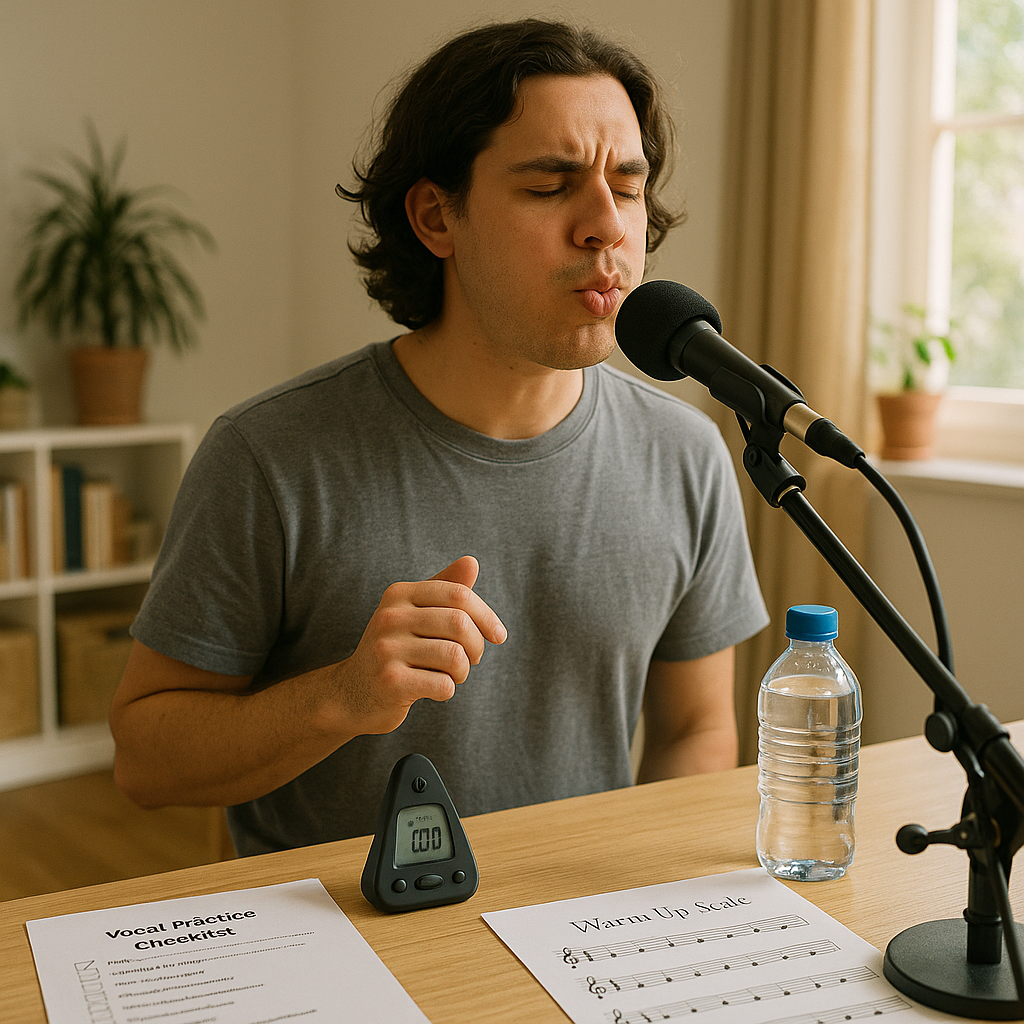
Effective vocal training happens through consistent daily practice rather than sporadic marathon sessions. Research shows our brains start to disengage from learning new physical skills after 20-25 minutes, making shorter, focused sessions far superior for building vocal strength and muscle memory.
The optimal approach involves 10-20 minutes of daily focused vocal training. This timeframe allows your voice to develop gradually without strain or fatigue. Some professional singers use a technique called “chunking” where they practice in 15-minute intensive sessions spread throughout the day, working on 2-3 specific exercises before taking breaks.
A complete daily routine should follow a structured progression that prepares your voice systematically. Start with physical preparation including deep breathing and gentle stretching to release tension in your shoulders, neck, and jaw. Your diaphragm controls the power behind your voice, so proper breathing from this muscle forms the foundation of all vocal work.
Breathing exercises like the hissing technique help establish diaphragmatic control. Stand straight, breathe in through your mouth for a count of five, allowing your belly to expand rather than your chest. Then exhale for nine counts while making a hissing sound like the first letter of “sizzle.” This exercise forces you to engage proper breathing muscles and builds the breath control essential for strong singing.
Gentle warm-ups should follow breathing work to prepare your vocal cords safely. Humming serves as an excellent starting point because it engages your vocal cords without strain. Place your tongue tip behind your bottom teeth and hum up and down major scales, ensuring each note includes the “h” sound. Lip trills offer exceptional value during warm-ups as they engage support muscles, relax facial tension, and provide beneficial back pressure on your vocal folds.
Core vocal exercises focusing on scales and arpeggios develop fundamental technique and vocal agility. Work through major scales using different vowel sounds, starting in your comfortable middle range and gradually expanding higher and lower. Arpeggios help you navigate between vocal registers smoothly while building familiarity with common musical patterns that appear in most songs.
| Phase | Duration | Exercises | Focus |
| Physical Prep | 2-3 minutes | Stretching, posture alignment | Release tension, establish foundation |
| Breathing | 3-4 minutes | Hissing exercises, diaphragmatic breathing | Breath control and support |
| Warm-Up | 3-5 minutes | Humming, lip trills, gentle sirens | Vocal cord preparation |
| Core Training | 5-8 minutes | Scales, arpeggios, vowel patterns | Technique and range development |
| Cool-Down | 2-3 minutes | Sirens, lip trills, gentle humming | Voice relaxation and recovery |
More challenging techniques like belting and advanced agility work should only be attempted after your voice is thoroughly warmed up. Practice the “dopey mum” exercise to create resonant space and neutralize your larynx position. This involves dropping your soft palate slightly as if beginning a yawn, then singing vowels with that expanded throat position.
Regular self-assessment accelerates improvement significantly. Record yourself practicing to track progress and identify areas needing attention. Many singers are surprised by what they hear versus what they feel while singing. Additionally, practice in front of a mirror to monitor for unnecessary tension in your face, neck, or shoulders, and to ensure proper mouth position and posture alignment.
Consistency trumps intensity in vocal development. Your voice responds better to gentle daily conditioning than to aggressive practice sessions followed by days of rest. This approach builds the vocal endurance and strength necessary for confident, sustainable singing while protecting your voice from injury and strain.
How Can You Develop Better Tone, Diction, and Vocal Expression?
Understanding and Developing Your Vocal Registers
Mastering vocal registers forms the foundation of quality tone production. Your chest voice produces the rich, powerful sounds you hear in songs like Adele’s “Rolling in the Deep,” where the lower register creates warmth and depth. Head voice, by contrast, delivers the soaring high notes that make Whitney Houston’s “I Will Always Love You” so memorable.
Practice transitioning between these registers by starting with simple scales. Begin in your chest voice on comfortable low notes, then gradually ascend while allowing your voice to naturally shift into head voice. The key lies in maintaining consistent airflow and avoiding tension as you move between registers.
Blending these registers creates your mixed voice, the sweet spot where most contemporary singing happens. Think of how John Legend seamlessly moves between registers in “All of Me” without noticeable breaks or shifts in vocal quality.
Controlling Your Soft Palate for Resonant Space
Your soft palate acts like an adjustable ceiling in your mouth, creating the resonant space that gives your voice richness and projection. When you yawn, you naturally lift your soft palate, creating more space for sound to resonate. This same feeling helps develop better vocal tone.
Practice this by humming with your mouth closed, then opening to “ah” while maintaining that lifted, open feeling. You should feel vibrations in your face and sinuses when you find the right position. This resonant buzz indicates proper soft palate positioning and vocal fold coordination.
Avoid letting your soft palate hang too low, which creates a muffled, nasal sound. Instead, imagine creating a cathedral-like dome in your mouth where sound can bounce and amplify naturally.
Achieving Proper Mouth Position and Jaw Placement
Your jaw position directly affects tone quality and vowel clarity. Drop your jaw with one to two fingers’ height between your teeth, creating space without strain. This relaxed position allows for better airflow and clearer articulation.
Many singers make the mistake of singing with a tight, barely open mouth. This restricts sound and creates tension throughout the vocal tract. Practice singing scales with an exaggerated open mouth position, then gradually find the sweet spot where openness meets comfort.
Check your jaw tension by placing your hands on your cheeks while singing. You should feel minimal movement and no clenching. If you detect tension, shake out your jaw and start again with a more relaxed approach.
Strengthening Articulation and Diction
Clear diction separates professional singers from amateurs. Practice singing with a pen held horizontally between your teeth to force precise lip and tongue movements. This exercise strengthens the muscles responsible for consonant formation and vowel shaping.
Exaggerate your lip movements while practicing lyrics, making every “P,” “B,” and “M” sound crisp and defined. Think of how Broadway performers project lyrics to the back row of a theater. Their exaggerated articulation ensures every word reaches the audience clearly.
Focus on consonant placement by practicing tongue twisters at various pitches. “Red leather, yellow leather” becomes particularly challenging when sung, but it develops the agility needed for rapid-fire lyrics in songs like Eminem’s collaborations with singers.
Mastering Vowel Modification and Shaping
Vowel modification is the secret weapon of professional singers. Open vowels slightly more than in normal speech, especially in higher registers. The “ah” vowel that works perfectly for speaking might need to shift toward “uh” when singing high notes to maintain clarity and avoid strain.
Practice pure vowel sounds (“ee,” “eh,” “ah,” “oh,” “oo”) on single pitches, ensuring each vowel maintains its distinct character. As you ascend in pitch, allow vowels to modify naturally rather than forcing them to sound identical to their spoken versions.
Listen to how Beyoncé modifies her vowels in “Halo” during the high notes. She maintains the essence of each vowel while allowing subtle adjustments that preserve both clarity and vocal health.
Implementing SOVT Exercises for Range Extension
Semi-occluded vocal tract exercises create back-pressure that helps coordinate your vocal folds more efficiently. Lip trills, humming, and singing through straws all fall into this category and serve as excellent warm-up tools.
Start your practice session with lip trills on scales, allowing the buzzing sensation to guide your voice through its range. This exercise helps identify areas of tension and promotes smooth register transitions. If your lips stop vibrating, you’ve likely encountered a tension point that needs attention.
Narrow vowels like “OO” and “EE” naturally create semi-occlusion, making them ideal for safely extending your range. Practice scales using these vowels before attempting the same passages with more challenging open vowels.
Adding Stylistic Elements and Emotional Expression
Vibrato, vocal fry, runs, and dynamic variations transform basic melodies into compelling performances. Vibrato occurs naturally when your voice is properly supported and relaxed. Rather than forcing it, focus on consistent airflow and let vibrato develop organically.
Vocal fry, when used sparingly, adds texture and emotion to phrases. Listen to how Billie Eilish incorporates subtle vocal fry in “Bad Guy” to create her signature intimate sound. However, avoid overusing this technique as it can strain your vocal folds.
Practice runs and riffs by starting slowly with simple patterns. R&B artists like Mariah Carey and Alicia Keys built their reputations on masterful melismatic singing, but they developed these skills through patient, methodical practice of basic patterns before attempting complex passages.
Exploring Genre Techniques and Vocal Styles
Each musical genre demands specific vocal techniques and stylistic approaches. Pop singing often emphasizes clean, precise delivery with controlled vibrato, while rock vocals might incorporate gravel and power. Jazz singing requires improvisational skills and sophisticated phrasing, and country music values storytelling through vocal nuance.
Study artists across genres to expand your technical toolkit. Notice how Amy Winehouse brought jazz phrasing to soul and pop music, or how Chris Stapleton combines country storytelling with rock power and R&B runs. These cross-genre influences create unique vocal signatures.
Experiment with different emotional deliveries for the same song. Sing a ballad with tender vulnerability, then try it with powerful conviction. These exercises develop your ability to match vocal technique with emotional intent.
Developing Harmonization Skills
Harmonizing begins with understanding how your voice fits within a musical context. Start by learning background vocal parts in your favorite songs, focusing on simple third and fifth intervals above or below the main melody.
Practice singing along with vocal groups like Pentatonix or The Beatles to develop your ear for harmony parts. Begin with the most prominent background vocals before attempting more subtle inner voices. This systematic approach builds confidence and accuracy in ensemble singing.
Use a piano or guitar to play chord progressions while improvising harmony lines. This exercise develops your ability to find harmonies instinctively rather than relying solely on memorized parts.
What Self-Assessment and Improvement Strategies Accelerate Progress?
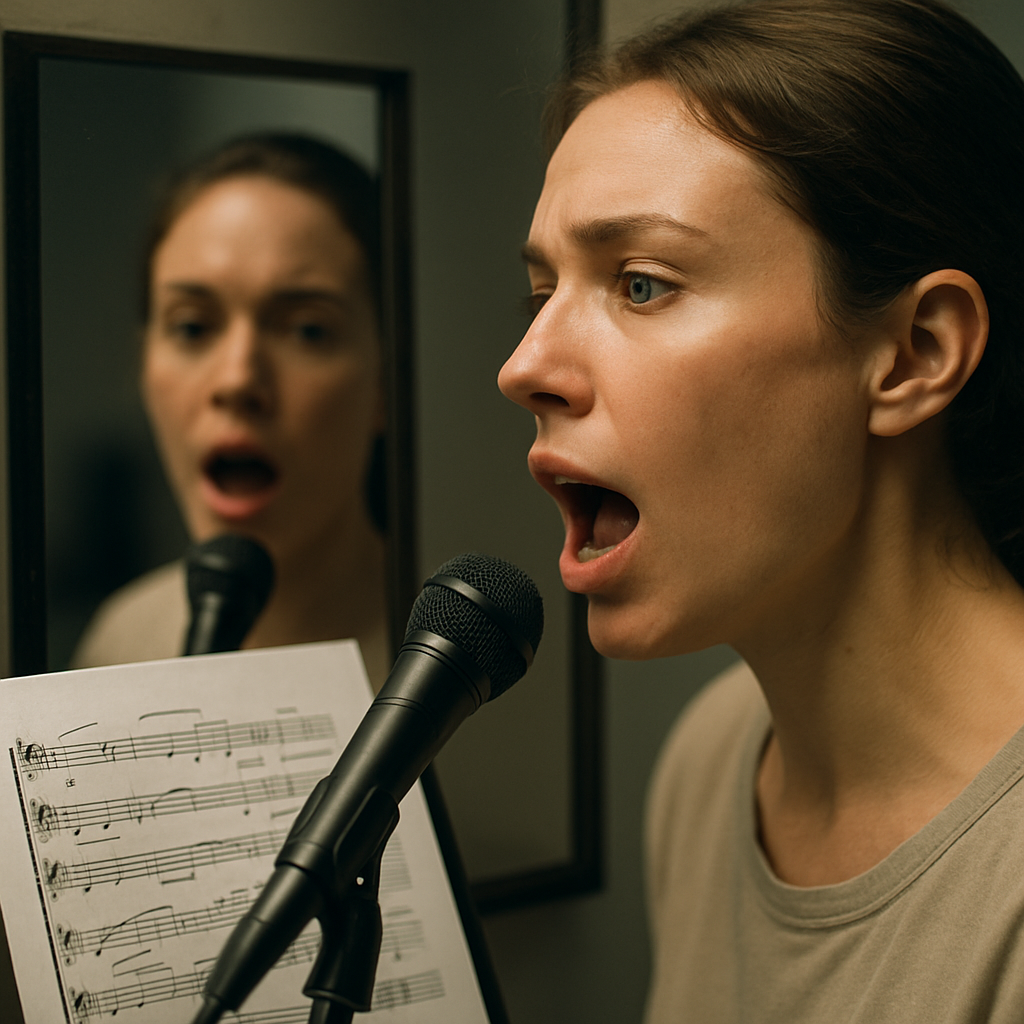
Recording yourself represents the single most powerful tool for vocal improvement. Your voice sounds completely different in your head compared to how others hear it. Grab your phone or recording device and capture yourself singing. This objective feedback reveals exactly where improvement is needed and provides concrete evidence of your progress over time.
Start your self-assessment journey by selecting three contrasting songs that challenge different aspects of your voice. Learn each song thoroughly before recording. Listen to your recordings with focused attention, assessing one element at a time during each playback.
Strategic Self-Evaluation Techniques
Effective self-evaluation requires systematic approaches rather than general impressions. During your first listen, focus solely on pitch accuracy and note any spots where you drift sharp or flat. On the second playback, concentrate on your breathing and breath support.
A third listening session should examine your tone quality and vocal consistency across different registers. This targeted approach prevents overwhelm and helps you identify specific areas needing attention. Keep detailed notes about what you discover during each focused listening session.
Seeking Constructive Feedback
External perspectives provide crucial insights that self-assessment alone cannot deliver. Find people who will offer honest but supportive feedback about your vocal abilities. Choose individuals who understand that your voice is a work in progress and won’t be overly harsh or discouraging.
Online communities and vocal forums can provide valuable input from fellow singers and teachers. Be prepared to receive feedback graciously and use it as fuel for improvement rather than criticism. Remember that people who genuinely care about your progress want to help you reach your singing goals.
Targeted Practice Based on Assessment
Once you identify specific weaknesses, research vocal concepts and exercises that directly address those issues. Avoid generic practice routines that don’t target your particular challenges. Test different sensations and cues to find what makes singing feel easier and sound better for your unique voice.
Deliberate practice means working on specific problems with focused attention rather than mindlessly repeating exercises. If you struggle with register transitions, spend concentrated time on blending exercises. When breath support becomes an issue, dedicate sessions specifically to breathing techniques and stamina building.
Applying Techniques to Real Songs
The biggest misconception among developing singers is that exercises alone create improvement. You must apply technical work to actual songs for meaningful progress. After practicing specific exercises, immediately work them into your song repertoire.
Break songs down note by note rather than singing them from start to finish repeatedly. Master individual phrases before attempting complete run-throughs. Ask yourself how techniques from your practice sessions can enhance each section of the song.
Work on fundamental skills like changing pitch without altering volume, mouth shape, posture, or airflow. These awareness-based approaches prevent aimless practice and create faster skill development. Record yourself applying new techniques to songs and compare these recordings to earlier versions.
Creating Continuous Improvement Cycles
Sustainable progress comes from establishing regular assessment cycles rather than sporadic evaluations. Set weekly recording sessions where you capture the same songs and exercises. This consistent documentation creates an objective timeline of your vocal development.
Track your progress in a practice journal alongside your recordings. Note which exercises helped with specific problems and which techniques improved particular songs. This written record helps you remember what works and prevents you from forgetting effective strategies.
Celebrate small improvements rather than waiting for dramatic breakthroughs. Vocal development happens gradually through accumulated small gains. Recognizing incremental progress maintains motivation and encourages continued effort toward your singing goals.